

Fleet Maintenance for Trucking Companies: A Growth Strategy for 2026
A single reactive breakdown can cost you nine times more than a planned service check, yet many fleets still wait for a warning light before taking action. You've likely felt the sting of a profit margin disappearing into an emergency repair bill or the stress of losing a long-term contract because of a delivery delay. It's exhausting to manage driver turnover when your team doesn't trust the equipment they're operating. Implementing a robust strategy for fleet maintenance for trucking companies is the only way to stop playing defense with your budget. You need a partner who understands that every hour your truck sits idle is an hour of lost revenue.
This article reveals how a proactive maintenance plan transforms your operational costs into a distinct competitive advantage. We'll explore how to achieve predictable expenses and maximum vehicle uptime while ensuring your fleet stays ahead of upcoming EPA 2027 emissions standards. You'll learn the specific steps to turn your shop schedule into a growth engine that protects your bottom line and secures your reputation for reliability. By shifting your focus from emergency repairs to precision maintenance, you can focus on scaling your business with confidence.
Key Takeaways
- Learn how to leverage a high-quality maintenance record as a tactical asset to win premium freight contracts and protect your profit margins.
- Identify the essential pillars of a commercial truck schedule that prioritizes diesel-specific expertise for maximum vehicle uptime.
- Simplify DOT compliance in the Tennessee and Kentucky region by using documented histories to breeze through annual inspection requirements.
- Evaluate the hidden costs of in-house repairs versus outsourcing fleet maintenance for trucking companies to significantly reduce your total cost of ownership.
- Understand why partnering with heavy-duty specialists allows you to scale your fleet faster without the overhead of specialized tool and parts inventory.
Beyond Repairs: Why Fleet Maintenance is a Strategic Asset
Fleet maintenance isn't just a list of oil changes or a stack of repair receipts. It is a comprehensive system of oversight that keeps your assets moving and your revenue flowing. When you treat fleet management as a core business function, you stop being a victim of mechanical failure. You start using your equipment as a tool for growth. Many operators view the shop as a cost center, but successful carriers see it as their strongest competitive advantage.
High-value shippers don't just look at your rates. They look at your safety scores and maintenance logs. They want to know their freight won't be stranded on a shoulder due to a neglected cooling system. A documented, high-quality maintenance record is often the deciding factor in securing premium contracts that demand 99% on-time delivery. Beyond the office, reliable equipment directly influences your driver satisfaction. Driver frustration peaks when they're stuck in a hotel waiting for a part that should have been replaced months ago. By providing reliable trucks, you lower recruitment costs and keep your best talent behind the wheel.
Think of proactive service as insurance against catastrophe. A simple sensor replacement today prevents a $25,000 engine overhaul next month. It is the only way to protect your fleet from the kind of catastrophic failures that can bankrupt a growing carrier. In an industry with thin margins, a single blown engine can wipe out a month of profit. Fleet maintenance for trucking companies is the shield that protects your cash flow from these unpredictable hits.
Shifting from Reactive to Proactive Operations
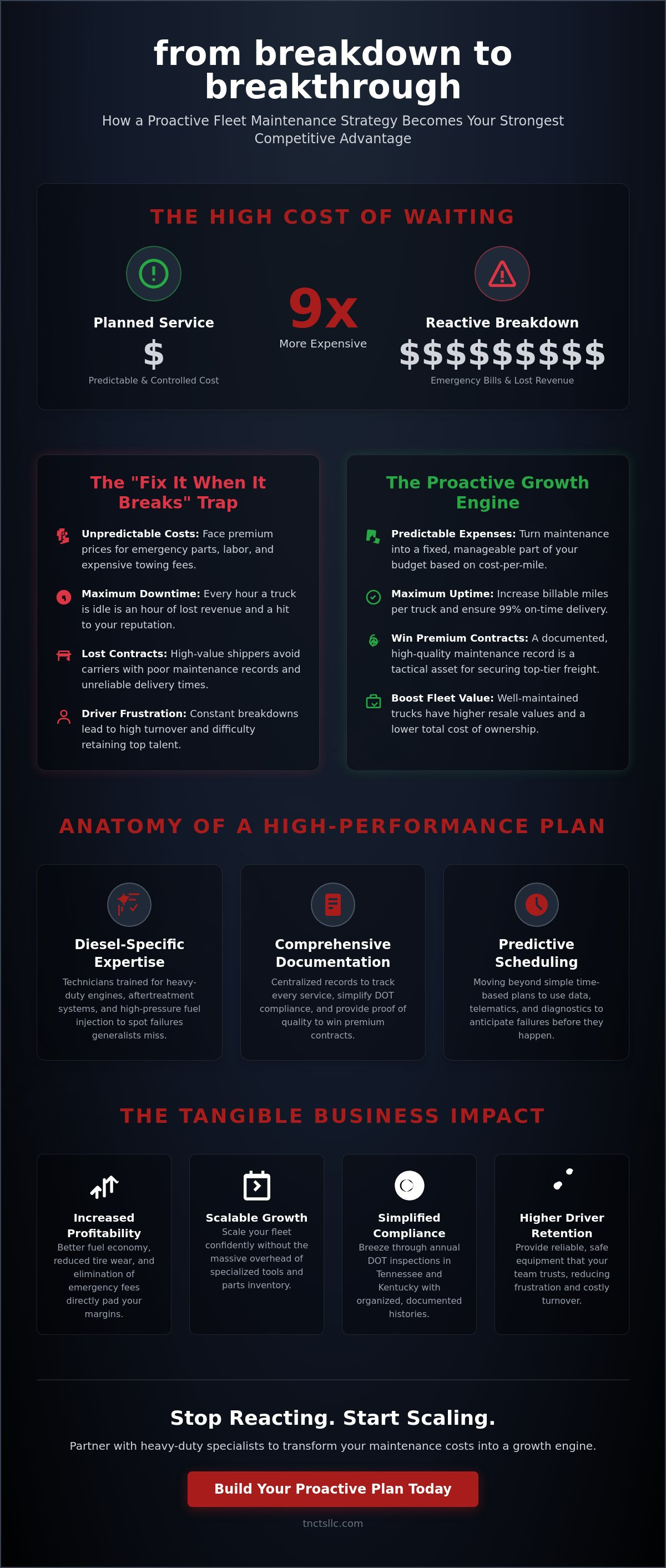
The "fix it when it breaks" model is a trap. It forces you to pay premium prices for emergency parts and rapid labor. Research shows reactive breakdowns can cost up to nine times more than planned preventive maintenance. A proactive approach focuses on the cost-per-mile. It catches a pinhole leak in a coolant hose before it results in a roadside emergency. Proactive maintenance is the foundation of logistics scalability.
The Impact on Your Bottom Line
Every day a truck sits in a bay is a day it isn't earning. Reduced downtime directly increases your billable miles per truck. Well-maintained diesel engines also operate more efficiently, sipping fuel instead of gulping it. Even a small increase in fuel economy across a fleet of ten trucks adds up to thousands of dollars saved annually. Properly aligned trailers reduce tire wear and aerodynamic drag, further padding your margins. You also avoid the sting of emergency towing fees, which often cost more than the actual repair.
The Anatomy of a High-Performance Maintenance Plan
A high-performance maintenance plan is more than a calendar of oil changes. It is a technical blueprint designed to eliminate the variables that cause downtime. Effective fleet maintenance for trucking companies relies on three core pillars: frequency, precision, and documentation. You cannot manage what you do not measure. Without a centralized system to track every service interval and vehicle history, you are essentially guessing at your fleet's health. Modern telematics and factory-embedded sensors now provide a wealth of data, but that information is only valuable if it leads to a decisive service action.
Diesel-specific expertise is non-negotiable in this process. Heavy-duty engines operate under extreme pressures and temperatures that passenger vehicle mechanics simply aren't trained to handle. A technician who understands the nuances of exhaust aftertreatment systems and high-pressure fuel injection can spot a looming failure that a generalist would miss. This expertise extends to the trailer as well. Trailers are often the most neglected assets in a fleet, yet they are responsible for a significant portion of roadside citations. A comprehensive plan treats the tractor and trailer as a single, integrated unit that must meet strict DOT Compliance and Safety Standards at every mile.
Preventative vs. Predictive Maintenance Models
Preventative maintenance is time-based or mileage-based. It's the traditional "change the oil every 15,000 miles" approach. While this is the baseline for any fleet, predictive maintenance is the future of growth. Predictive models use oil analysis and vibration diagnostics to anticipate when a specific component will fail. If an oil sample shows high levels of copper or lead, you know a bearing is wearing out before the engine seizes. This allows you to set realistic service windows for high-mileage fleets, ensuring you only pull a truck off the road when it's truly necessary.
Critical Components: Engines, Trailers, and Brakes
Diesel engine health depends on the integrity of the cooling system and the cleanliness of the Diesel Particulate Filter (DPF). A clogged DPF will eventually force a truck into a derate condition, leaving your driver stranded. Trailers require dedicated attention to wheel seals, air lines, and reefer unit servicing. A leaking wheel seal isn't just a maintenance issue; it's a fire hazard. Brakes remain the top priority for both safety and compliance. They are the most frequent cause of out-of-service orders during roadside inspections. Partnering with a team that provides expert diesel engine services ensures these critical systems are inspected with professional-grade precision.
Navigating DOT Compliance and Safety Standards in Tennessee
Compliance is the backbone of a legal operation. In Tennessee, any commercial vehicle with a GVWR over 10,001 lbs must pass an annual DOT inspection to remain on the road. This isn't just about a sticker on the windshield. It's about adhering to Federal vehicle maintenance regulations that require every carrier to systematically inspect, repair, and maintain all motor vehicles under its control. When you prioritize fleet maintenance for trucking companies, you create a digital or paper trail that serves as your best defense during a roadside stop or a full-scale audit. A documented history proves you aren't just reacting to problems. It shows you're actively managing your fleet's safety.
Operating non-compliant equipment carries severe financial and legal risks. Beyond the immediate fines, a poor safety record can lead to increased insurance premiums or even the loss of your operating authority. In the TN/KY region, where freight volume is high, law enforcement is vigilant. If your equipment looks neglected, you're inviting a level of scrutiny that your schedule can't afford. Consistent maintenance ensures that when your truck is pulled into a scale, it leaves just as quickly as it arrived.
Understanding Local Inspection Requirements
DOT inspections range from Level I to Level VI, each focusing on different aspects of the vehicle and driver. A Level I inspection is the most thorough, involving a complete check of both the driver's credentials and the vehicle's mechanical integrity, including a look underneath the chassis. Common red flags that lead to immediate roadside shutdowns include inoperative lighting, audible air leaks, and tires with insufficient tread depth. Maintaining clean CVSA scores is essential for your company's reputation, as these scores are public and used by shippers to vet potential partners.
Avoiding Roadside Violations on the I-24 Corridor
The I-24 corridor between Clarksville and Nashville is one of the most heavily patrolled stretches in the Southeast. Weigh stations near the Tennessee-Kentucky border are frequently active, and local DOT officers are trained to spot equipment failures from a distance. Proactive maintenance prevents "out-of-service" orders that kill your delivery timelines and frustrate your customers. Most inspections are triggered by simple, visible issues like a cracked mirror or a flickering marker light. If an officer spots these, they have probable cause to pull you in for a full inspection. Don't let a minor lighting issue turn into a three-hour delay and a permanent mark on your safety record.
Outsourcing vs. In-House: Evaluating the Total Cost of Ownership
"Is it really cheaper to do it ourselves?" This is the primary objection fleet managers raise when reviewing their annual budgets. On the surface, avoiding a third-party labor rate feels like a smart financial move. However, the reality of running an in-house shop often creates a massive financial leak that drains your resources. You're no longer just a logistics provider; you're now a facility manager. You have to handle environmental disposal fees, property taxes, and specialized garage-keepers insurance. When you outsource fleet maintenance for trucking companies, you convert these heavy fixed costs into manageable variable expenses. You only pay for the work performed, not the downtime of an idle shop or an underutilized technician.
The Hidden Costs of In-House Shops
The investment required for modern diesel diagnostics is staggering. Software subscriptions for various engine makes can cost thousands of dollars annually. Beyond software, you need heavy-duty lifts, specialized torque tools, and tire machines. Then there's the human element. Hiring and retaining skilled diesel mechanics is incredibly difficult in the current market. You aren't just paying a wage; you're paying for health insurance, workers' comp, and ongoing training. If your lead technician leaves, your entire maintenance program collapses. There's also the liability risk. If an in-house repair fails on the highway, your company shoulders 100% of the legal and financial responsibility for the outcome.
Maximizing Uptime through Dedicated Partners
A dedicated partner provides a level of speed and precision that internal shops rarely match. They have the volume to justify stocking a massive parts inventory, meaning your truck isn't waiting three days for a simple sensor. They also provide a service history that follows the vehicle, which is vital for resale value and compliance audits. Most importantly, a professional partner offers 24/7 support. Internal shops usually close at 5:00 PM, but trucks break down at all hours. Having a partner that offers 24 hour truck repair ensures your equipment stays on the move regardless of the clock. It's time to evaluate their current downtime costs and see how much your in-house shop is truly taking from your profit.
Outsourcing allows your team to focus on what you do best: moving freight and growing your customer base. Let the specialists handle the grease and the gear ratios while you handle the growth. Partner with a professional maintenance team to streamline your operations and protect your bottom line today.
Partnering with Complete Truck Services for Scalable Growth
Complete Truck Services LLC stands as the premier local partner for carriers looking to dominate the TN/KY freight market. We don't just fix trucks; we build the mechanical foundation that allows your business to scale. Our facility in Clarksville, TN, is designed to handle the high-volume needs of modern logistics. We focus exclusively on semi-trucks, trailers, and diesel engines. This specialization ensures that every technician working on your fleet is an expert in heavy-duty systems. When you trust us with fleet maintenance for trucking companies, you're gaining a partner that understands the high stakes of your industry.
Our approach is built on the belief that maintenance should never be a bottleneck. We
Secure Your Fleet's Future in 2026
Success in the modern logistics landscape requires a shift from survival to strategy. By moving away from reactive repairs and embracing a proactive model, you protect your thin margins and build a reputation for unwavering reliability. You've seen how expert oversight simplifies DOT compliance and how outsourcing to dedicated specialists eliminates the heavy overhead of an in-house shop. Effective fleet maintenance for trucking companies isn't just a line item; it's the engine that drives your business toward scalable growth.
Complete Truck Services LLC provides the technical precision and local expertise you need to stay ahead. As a locally owned and operated partner in Clarksville, TN, we offer expert diesel engine diagnostics and the security of 24/7 Emergency Road Rescue. Don't let mechanical failure dictate your delivery schedule or drain your profits. Take control of your operations and ensure your equipment is ready for every mile ahead. Get a Custom Fleet Maintenance Quote from Complete Truck Services and start building a more resilient, profitable fleet today.
Frequently Asked Questions
What is included in a standard fleet maintenance program?
A standard program includes comprehensive mechanical and safety inspections designed to catch wear before it leads to failure. We perform oil and filter changes, chassis lubrication, brake system testing, and tire pressure adjustments. Our technicians also conduct thorough checks of the electrical system and diesel aftertreatment components to ensure your fleet remains efficient and reliable on the road.
How often should semi-trucks undergo preventative maintenance?
Most heavy-duty trucks require a preventative service every 15,000 to 25,000 miles, though this varies based on the engine manufacturer and your specific duty cycle. We recommend a tiered service schedule that alternates between basic inspections and more intensive system flushes. This rhythm ensures that high-wear items like wheel seals and cooling system hoses are never neglected.
Can outsourcing fleet maintenance really save my company money?
Yes, outsourcing eliminates the massive fixed costs of tool investments, shop leases, and technician benefits. By choosing fleet maintenance for trucking companies through a dedicated partner, you only pay for the work performed. You also benefit from our specialized diagnostic software and established parts supply chain, which reduces the total cost of ownership for every truck in your fleet.
How does fleet maintenance help with DOT compliance?
Systematic maintenance ensures your equipment meets federal safety standards before it ever reaches a weigh station. We perform pre-inspection checks that mirror Level I DOT requirements to identify issues like audible air leaks or lighting failures. Maintaining these digital records provides the proof of oversight required during a DOT audit and protects your company's safety rating.
What are the most common causes of truck downtime?
Electrical failures, tire blowouts, and cooling system leaks account for the majority of unexpected roadside stops. Aftertreatment system issues, such as a clogged DPF, also frequently force trucks into derate conditions. Our proactive diagnostic process identifies these emerging problems early, allowing us to perform a controlled repair in the shop rather than an emergency fix on the shoulder.
Do you provide maintenance for both trucks and trailers?
Yes, we provide expert service for both semi-trucks and trailers to ensure your entire combination is safe. Our trailer services include brake adjustments, air line repairs, wheel seal replacements, and reefer unit maintenance. Neglecting the trailer is a common cause of roadside citations, so we treat the tractor and trailer as an integrated unit during every inspection.
What happens if a truck in my maintenance program breaks down on the road?
You have immediate access to our 24/7 Road Rescue service for rapid intervention. Our mobile technicians respond with the specific tools and parts needed to perform a 24 hour truck repair on-site. This safety net ensures that even when the unexpected happens, your downtime is kept to an absolute minimum and your freight stays on schedule.
How do you track the maintenance history for my fleet?
We maintain precise digital records for every vehicle enrolled in our fleet maintenance for trucking companies program. These logs track every service interval, part replacement, and inspection result. This data is essential for managing your long-term repair budget and provides a clear audit trail that simplifies compliance and increases the eventual resale value of your equipment.